06/09/2008

People Living With HIV/AIDS

Hamjambo!

It’s September now. Here in Tanzania, the National Exam for Standard 7 will be held on 10, 11 September, so the staff in the Department of Education in Temeke are very busy for its preparation. This is the exam held at the end of the education in primary schools. The results influence students’ allocation to secondary schools.

As you see in the title of today’s diary, I’ll write about the People Living With HIV/AIDS (PLWHA) in Tanzania briefly. Here in Tanzania, it is estimated that about 7 % of people aged 15 to 49 are infected by HIV virus. It is quite a big number, so you cannot avoid coming across PLWHA.

The other day, I visited several families who have HIV patients at home. There are several local groups doing activities for HIV issues in Temeke area, where now I am working. The members of one of those groups escorted me then. Also some of the members are PLWHA. They look very fine and can do any activities. They said that they started taking medicine and proper treatment so that they are fine now, but before some of them were suffering very much. Now I see HIV is not necessarily fatal any more, though it is still serious disease.

Then what makes HIV/AIDS so special among several disease? Probably, still there is discrimination and segregation for the patients and infected people, and they are somehow afraid that they may be victims, I guess. However, I have an impression that in Tanzania, those people are relatively well accepted by society, and people know about this disease well. Children are well informed at school.
If I think about the situation in Japan, my country, probably many of us still lack of knowledge and concern about this disease. Or some of us may misunderstand this disease or how to prevent this disease. Probably there are many things we should learn from the experience of Tanzania about this issue.
Totaonana tena.
(The booklet explaining the national policy to prevent HIV/AIDS for young people.)

30/08/2008

About my work in Tanzania

Hamjambo!

I started my work in Department of Education in Temeke Ward Council from this month. I travel from the centre of the city to suburb by daladala(city bus) every day. I leave my house around 6:20 in the morning and arrive around 7:15. I am supposed to be in the office by 7:30.

Some of the officers in my department come around 6:00 in the morning. One of my colleagues come very early, so she does some work before I arrive. Then, "chai time" starts around 9:00. Tanzanians have tea and some snacks, such as chapaty, donuts, kitunbuu(snacks like a donut made by rice) and so on. Here, chai means "breakfast." Everyday, my colleagues give me chapaty, donuts and so on...

I need to used to this cycle of meals. Normally I have lunch around 2 p.m. Or sometimes I don't eat anything until dinner, since I don't feel hungry.

About my work, I decided to work as an assistant at a certain primary school. I am assigned to work for the youth out of school, which means the youth who dropped out from school. However, I thought I need to know about the educational system in this country, so I decided to visit schools. Here, the government is now enhancing secondary education, so in Temeke Ward where I am working, more than 20 secondary schools opened this January.

I visited just two primary schools, but there weren't enough number of textbooks, desks, teaching materials and so on. I guess, secondary schools are in the similar condition...

I have no big fund support from the Japanese government, so now I am thinking what I can do here in Tanzania.

I am going to visit more schools and visit more youth groups out of school.

Tutaonana tena.

27/07/2008

One month has passed

Hamjambo!
Hi. I am really sorry I didn't renew the page.

Then what have I done until now??? The JICA office gave us several lectures such as security, traffic, health and so on. We even visited the hospitals we may use in Dar-es-Salaam. Though we cannot see so many good hospitals, the hospital we visited are very equipped. I can say one of the hospitals is bigger than the hospital in my local city in Japan.

Also, we had a language training. We had very intensive Swahili training again here in Tanzania. Then, in the middle of the training, each of us visited our working place and met our colleagues. I visited the Department of Education in Temeke region in Dar-es-Salaam. I am excited to start working there, though I am concerned about my language ability as well.

Last week, I also visited another senior JOCV menber in Dodoma, which is actually the capital city of Tanzania. Dodoma is located in the almost central of Tanzania. It took about 7 hours by bus. Since the road from Dar. to Dodoma is quite good, the travel was really comfortable.
The senior volunter works in the Department of Education in Dodoma. Elementary schools in Dodoma are now promoting educational program for AIDS. She visits schools and supervise how the program is going on. At the office, I was shocked to hear that more than 10 girls of elementary schools were pregnant last year. However, the number has dicreased since the program was introduced.

I may have to come across the similar issues after I started working in Temeke. Two weeks later, my work will start.

Tutaonana tena.

29/06/2008

Now I am in Tanzania

Hamjambo!

Hi. I am writing this from Tanzania.

I arrived at the airport around 3p.m. on 25th. We have already spent 4 days here in Tanzania.
Now the rainy season is over, and it is said that now is the best season to visit Tanzania. It isn't too hot.

Dar es Salaam, which is the largest city in Tanzania, has many hotels, shops, good roads, and also very nice beach. You may see sharks around some beach, so it is dangerous to swim there, but the sea is very beautiful. (I guess the sea in the Zanzibar islands must be much more beautiful.)

Since we arrived here, we saw many Japanese used cars which have many Japanese letters on the bodies. It made me feel very strange. I heard one story about these. One Japanese happend to take a local bas here in Dar es Salaam, and the bus was the same bas which he used to use when he was a little boy to go to his kindergarden every day.

From next week, the Swahili training will start again, but now I am a bit relaxed.

I'll write again.

Tutaonana tena

22/06/2008

I visited the mayor and the governor.

Hamjambo!
I am home now. I'll leave for Tanzania on 24 June from Kansai Airport, but for a while I am home to prepare for my trip.

Also we, the JOCV (Japan Overseas Cooperation Volunteers), are assinged to visit the mayors and the governors of our home town. I visted the Yokkaichi mayor the other day. Three of us visited hime together. By a curious coincidence, it was found that three of us graduated the same elementary school! From the small local town, three people will leave for Chili, Cambodia and Tanzania in this month.

The next day, four of the JOCV members who are from Mie Prefecture. Four of us visited the deputy governor. Three of us are teachers, and we will be officially sent to other countries. After one year and monthes, we will be back to the same school and work again.


These are the four JOCV members who are from Mie Prefecutre, and each of us is going to Chili, Cambodia, Tanzania and Ghana.

Tutaonana tena.

13/06/2008

The training is over.

Hamjambo!

Yesterday was the last day of our training. About 160 trainees spent 65 days in the traning center together.

The day before, we did the 10minutes presentation in the class. My classmates spoke about their job, hometown and so on in Kiswahili. I spoke about my students a little and Korean drums and the music. To be honest I couldn't understand all of what my classmates talked, however, I could understand most of their speech and I could ask some questions in Kiswahili. I realized what we have obtained for these two months, and I appreciated my teacher who taught us very patiently and enthusiasticly.
We gave present to my teacher after the last lesson, and my teacher said, " I am happpy that you made efforts. However you should continue to work hard even in Tanzania. Study study study until December, then you will be able to communicate well."
On the last day of the training, we had a graduation ceremony and reception. Thinking about the 65 days traning, it was not so long but not short, I had feeling something happy and sad to farewell friends, teachers and staff. We, the trainees, will be sent to over 25 countries all over the world, mainly Africa and Asia. I just hoped every trainees will be fine and do their assingment well and all of us will return to Japan safely two years later.
I will be at home until 24 June.
Asante sana. Kwaheri. Tutaonana tena.
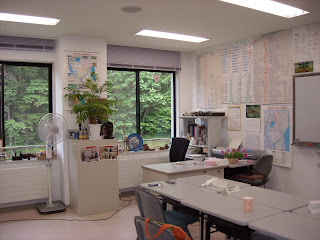
Photo: Our favourite classroom.

01/06/2008

Outdoor Lesson

Hamjambo!

This week we had two big events. One was "Outdoor Lesson", and the other was "The International Exchange Day" As for outdoor lesson, we went to the farm garden with our teacher and we used our target languages in real situation. The day we went out was a sunny day, and it was really good day to go out. We went to Miharu Farm Garden by train and taxi. My teacher is always very enthusiastic to teach new expressions in Kiswahili, so her lesson started immediately after we, the students, met her at the station.

We saw beautiful flowers and had lunch at the organic food restaurant. Even during the lunch time, my teacher wrote down some new words for us. It was a good opportunity to learn words and phrases in such a situation. She looked happy in the garden or happier than usual , since she always loves flowers, and she often brings flowers in the classroom.

Something hard is waiting after something fun. We had to write a report on the outdoor lessaon in Kiswahili on the day. As for me, it took nearly an hour to finish it...Anyway, it was a really good program.

Next time I'll write about the International Exchange Program.

Tutaonana tena. (see you again.)